
Jane Austen’s England
Regency era fashion
What women and men wore in Jane Austen’s England
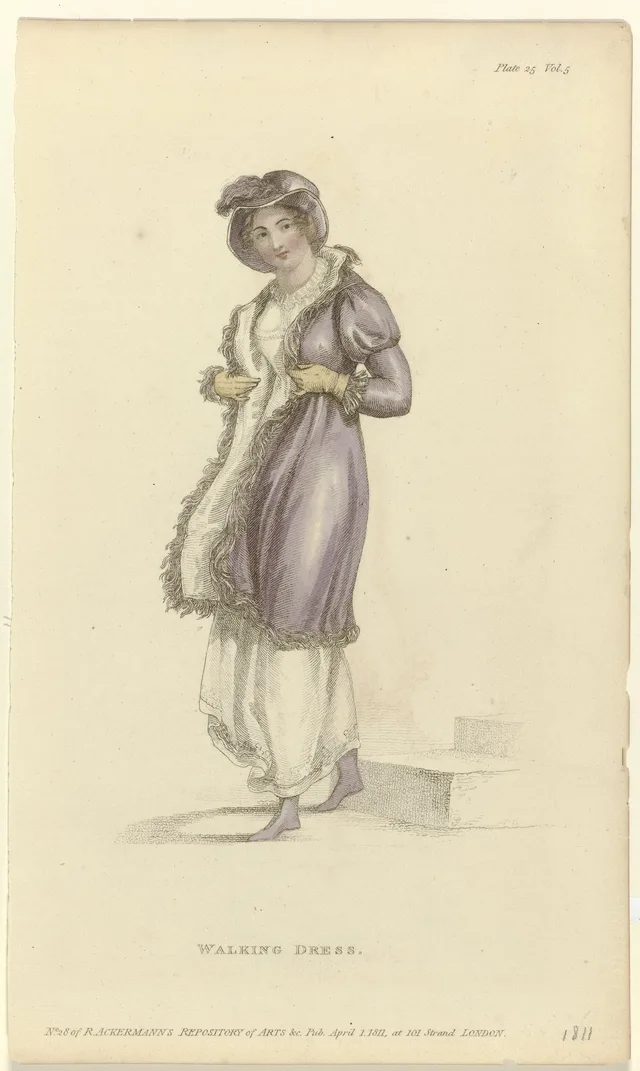
Regency era fashion is the high-waisted, column-like style of roughly 1795 to 1820, the years of Jane Austen’s novels: light white muslin gowns for women, inspired by Greek and Roman statues, and dark tailcoats, pale breeches and crisp white cravats for men. Here is every layer, from the shift to the bonnet, with fashion plates from the period.
Regency era fashion at a glance
- When
- The Regency proper ran from 1811 to 1820; the fashion is usually dated about 1795–1820
- Silhouette
- A slim column with the waist just under the bust, often called the Empire line
- Inspiration
- Classical Greek and Roman statues, and the simpler dress of revolutionary France
- Fabric
- White and pale cotton muslin by day; silk and satin for evening; wool for men
- Women’s layers
- Shift, short stays, petticoat, gown; spencer or pelisse, bonnet, gloves outdoors
- Men’s layers
- Shirt, cravat, waistcoat, tailcoat, breeches or pantaloons, boots, top hat
What is Regency style fashion?
Strictly, the Regency is the nine years from 1811 to 1820 when the future George IV ruled as Prince Regent for his ill father, George III. Fashion historians use the name more loosely for the whole style that came in during the 1790s and lasted until waists began to drop and skirts to widen in the 1820s. It sits between the wide hoops and powdered hair of the Georgian court and the corseted, full-skirted Victorian age.
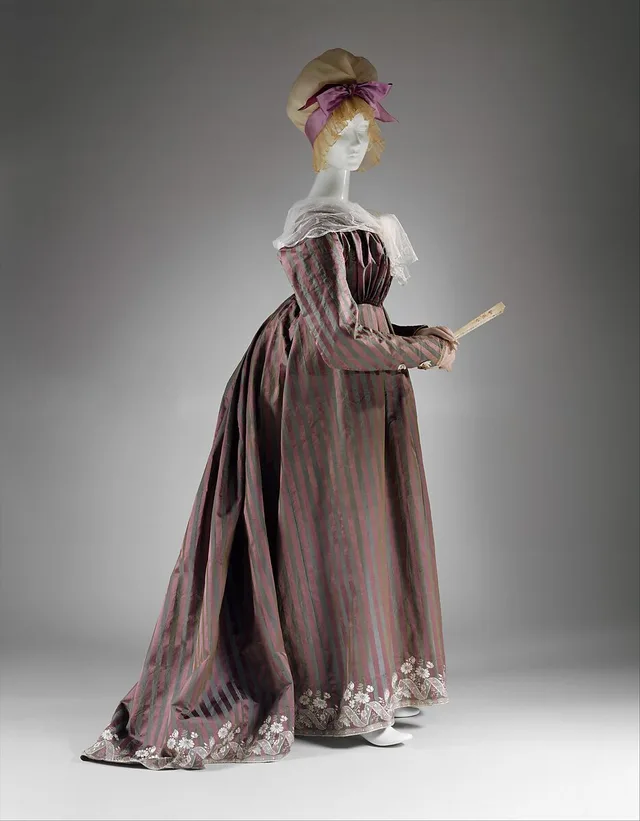
Its look came from two places. The French Revolution made the stiff, expensive court dress of the old regime unfashionable; and a passion for ancient Greece and Rome, fed by archaeology and by Napoleon’s imperial style, made women want to look like classical statues. Hence the high waist, the straight fall of the skirt, the pale colours that suggested marble, and the short curled hair and bandeaux. The French called the late-1790s version “Directoire” and the later one “Empire”, after Napoleon’s empire of 1804, which is where “Empire line” comes from.
Austen was not a slave to it. Her narrator in Northanger Abbey reminds readers that “dress is at all times a frivolous distinction, and excessive solicitude about it often destroys its own aim”, and the same novel gives us Mrs Allen, who can think of nothing else.
Regency fashion for women, layer by layer
A gentlewoman dressed from the skin outwards in several layers, most of them white linen or cotton that could be washed:
| Layer | What it was |
|---|---|
| Shift (chemise) | A loose linen or cotton undergarment worn next to the skin, changed and washed often |
| Stays | A corset, usually short or of moderate length, that lifted and supported the bust under the high waist rather than shaping a small waist |
| Petticoat | One or more underskirts, often bodiced, to give the gown its smooth fall and make thin muslin decent |
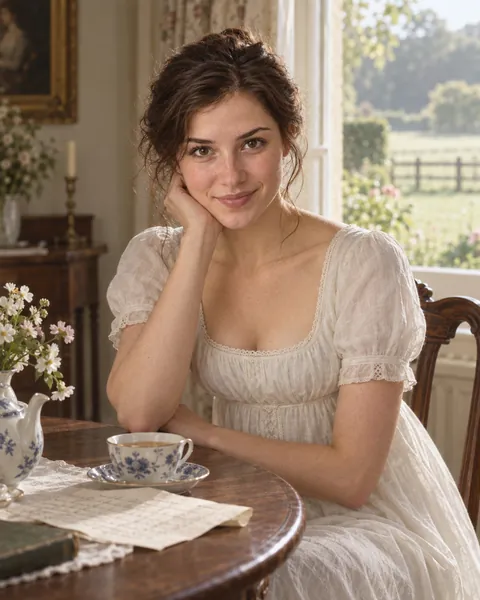
| Gown | The dress: a “round gown” (closed all round) of muslin, cambric or printed cotton, high-waisted, with long or short sleeves |
| Chemisette or fichu | A sheer infill or a folded kerchief to cover the neck and shoulders of a day dress |
| Stockings and shoes | Silk or cotton stockings, gartered at the knee; flat slippers indoors, half-boots for walking |
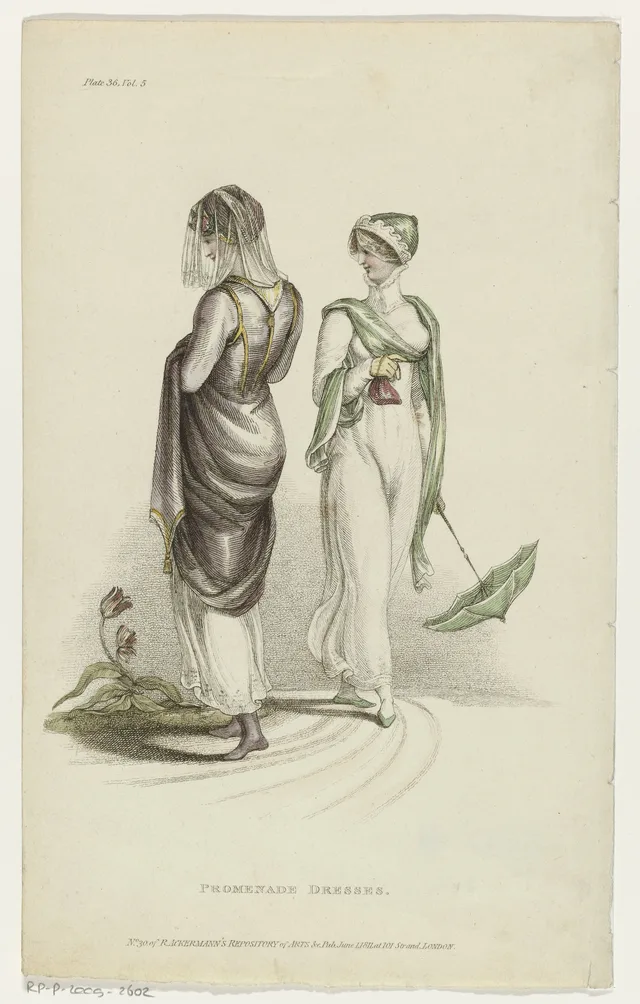
Why were Regency dresses so high-waisted?
Because the ideal was a classical column, and the high waist, placed just under the bust, made the body look long and the skirt fall straight like the drapery of a Greek statue. It also suited light fabrics that would not hold a fuller shape. As the 1820s began, the waist crept down, sleeves swelled and skirts widened into the shapes of the Victorian age.
Did women wear drawers?
Mostly not. Drawers for women were still uncommon in Austen’s lifetime and only became normal underwear in the 1820s and 1830s. A Regency woman’s underwear was her shift, stays and petticoats.
Spencers, pelisses, bonnets and shawls
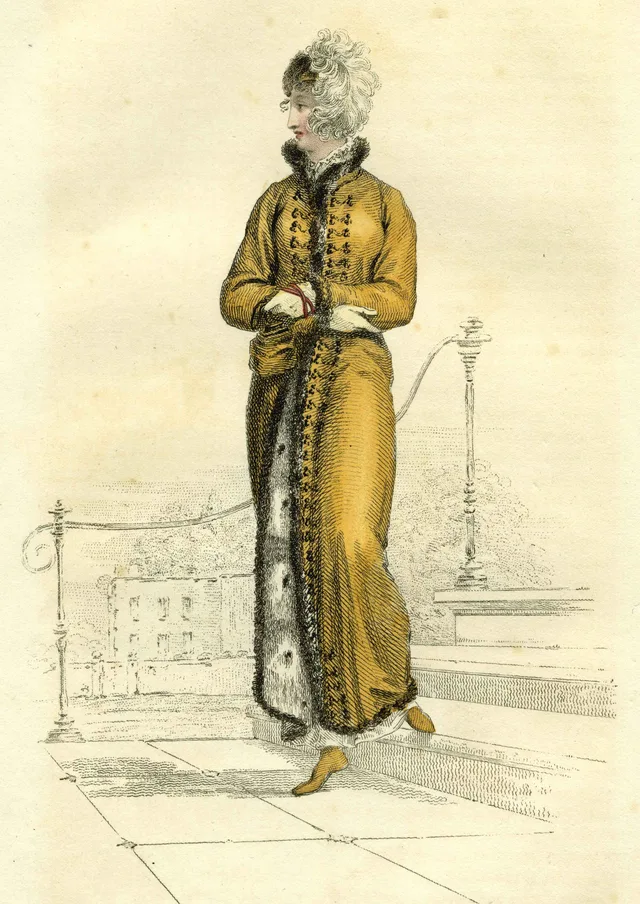
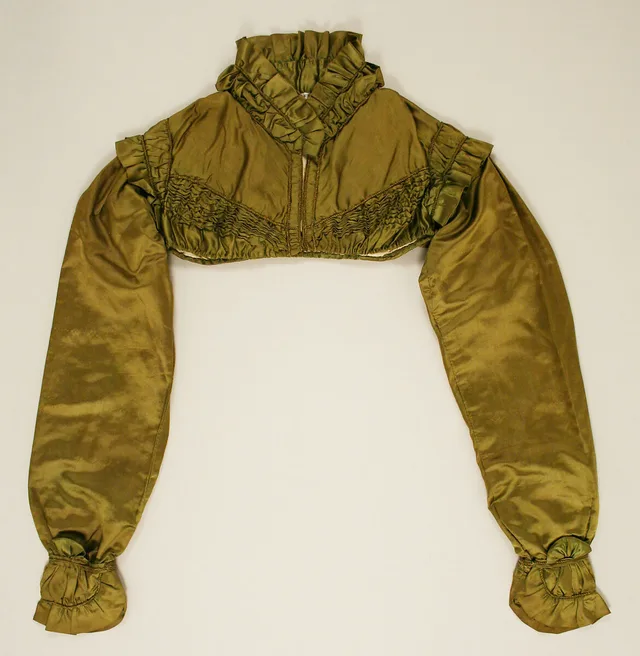
Thin muslin was cold, so outdoor dress was all about the layer on top:
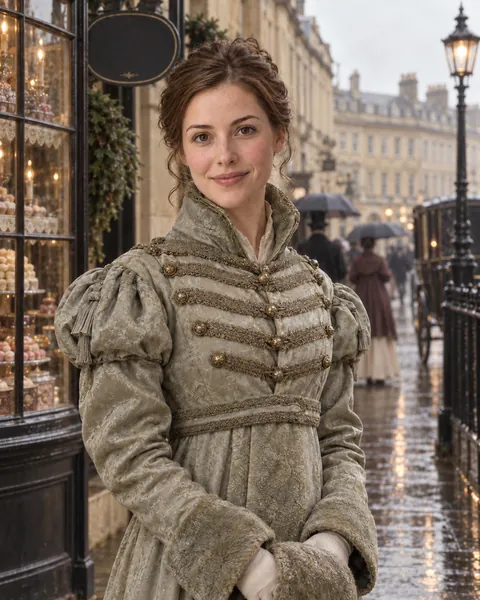
- Spencer: a short, close-fitting jacket ending at the high waistline, often in a contrasting colour, perfect for a walk.
- Pelisse: a coat-dress of the same length as the gown, often wool or silk and sometimes fur-trimmed, for cold weather and travel. A redingote was a similar riding-coat style.
- Shawl: large shawls of fine wool from Kashmir, or the cheaper imitations, were draped over the arms and treasured.
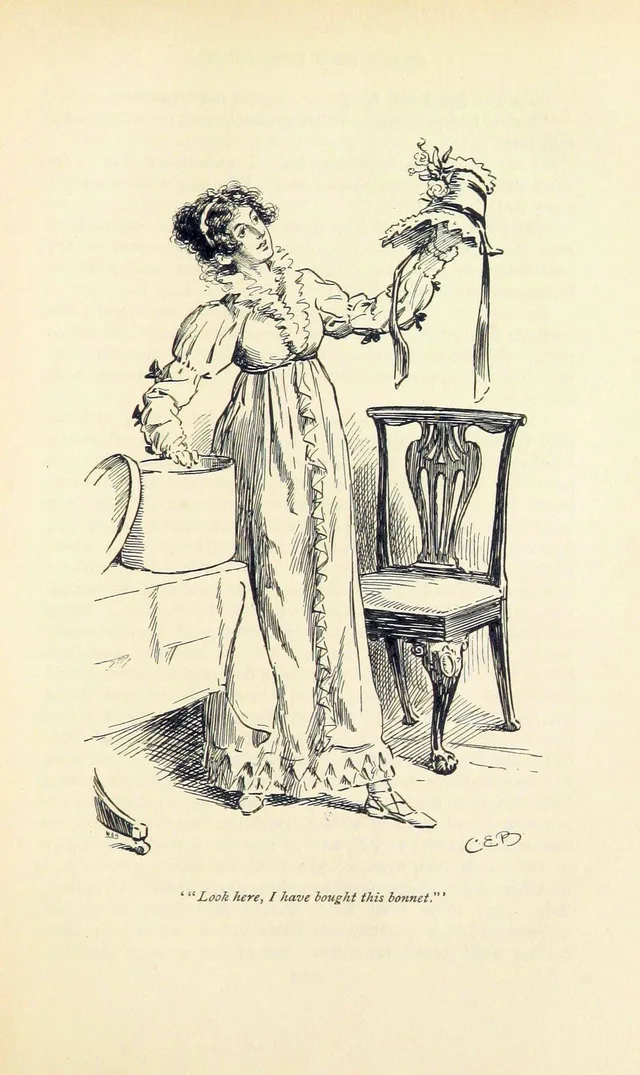
- Bonnet: straw or silk, from close “poke” bonnets that framed the face to taller styles trimmed with ribbons and feathers. Lydia Bennet buys one in Pride and Prejudice because she “might as well buy it as not”.
- Gloves and reticule: gloves were essential outdoors and at evening parties; with no room for pockets under a slim gown, women carried small drawstring bags called reticules.
Evening dress and the Regency ball gown
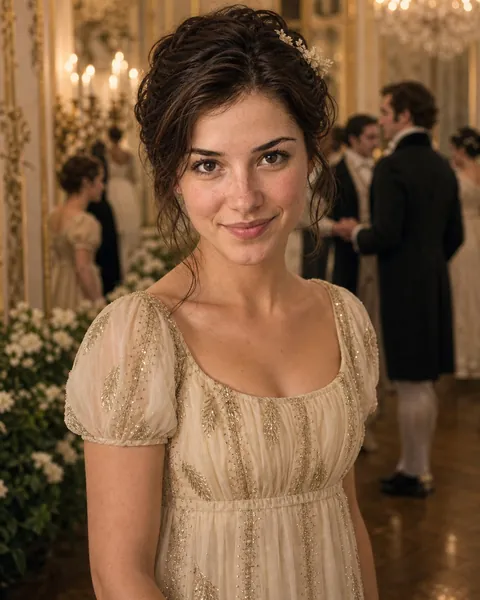
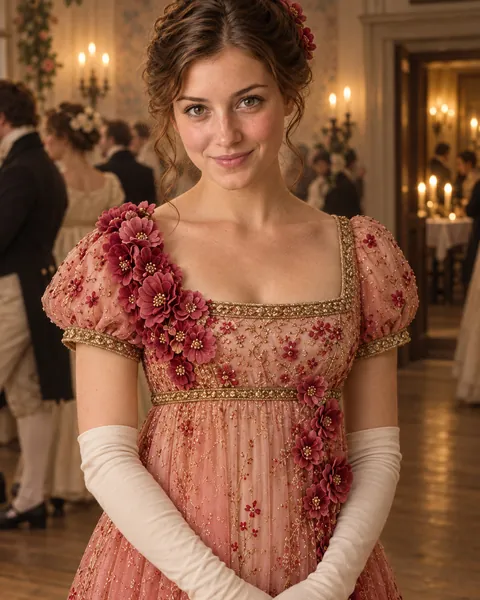
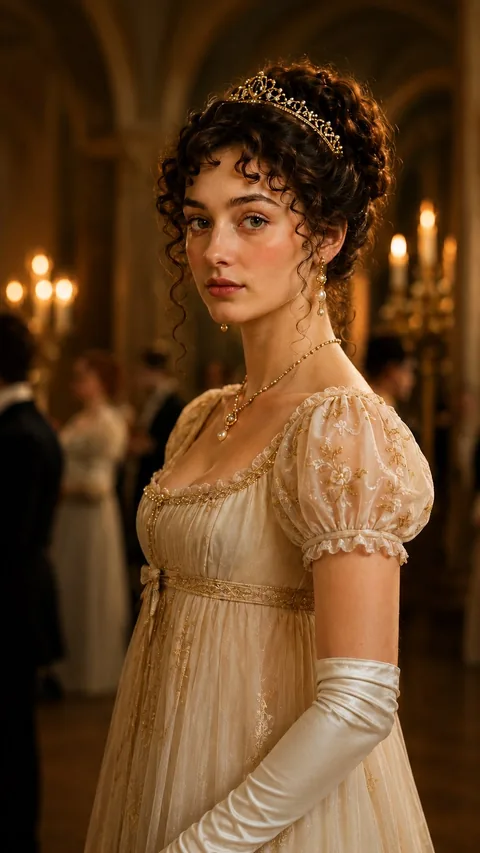
For dinners and balls, a woman changed into a gown of finer stuff: silk, satin or the sheerest muslin, often over a coloured slip. Necklines were lower and wider, sleeves short and puffed, and long white kid gloves came up past the elbow. Hair was dressed high with curls at the face and finished with ribbons, flowers, bandeaux, combs or, for older women, turbans and feathers. Dancing slippers were flat, thin-soled and quickly worn out.
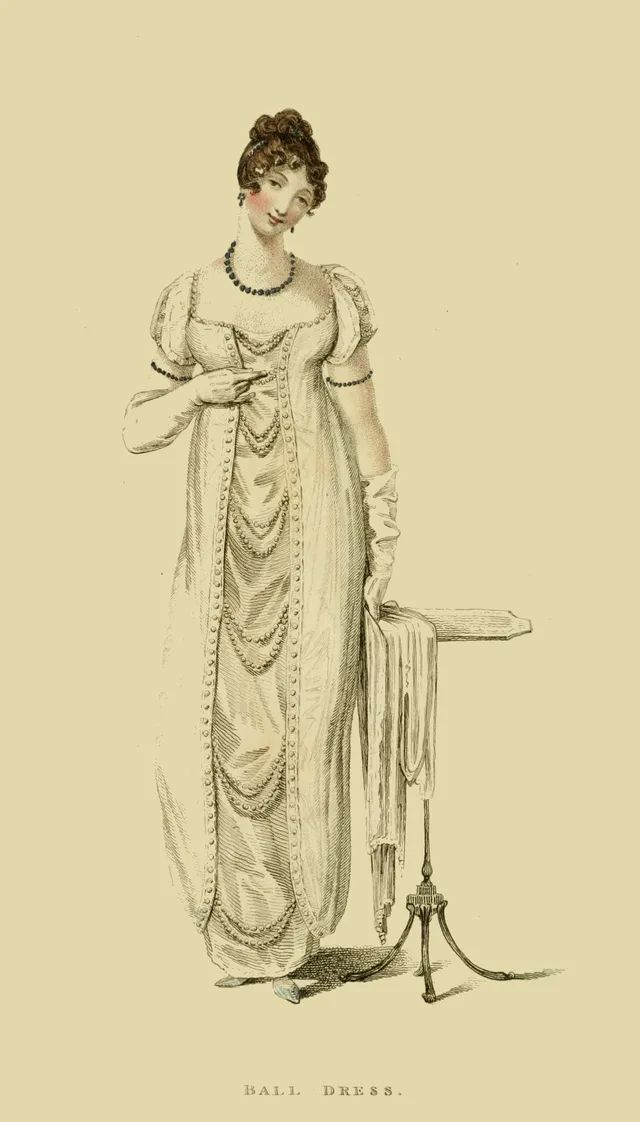
At court, the old rules lingered: ladies presented to the Queen still had to wear hooped skirts under their high-waisted bodices until the custom was dropped in 1820, a famously awkward combination. Muslin, meanwhile, was everyone’s obsession. In Northanger Abbey the hero, Henry Tilney, startles Mrs Allen by judging her gown expertly: “I always buy my own cravats, and am allowed to be an excellent judge; and my sister has often trusted me in the choice of a gown.”
Wear it first: Regency gowns in the app
-
 Elizabeth Bennet
The Netherfield Ball
Sit as Elizabeth Bennet
-
 Elizabeth Bennet
Morning at Longbourn
Sit as Elizabeth Bennet
-
 Emma Woodhouse
The Ball at the Crown
Sit as Emma Woodhouse
-
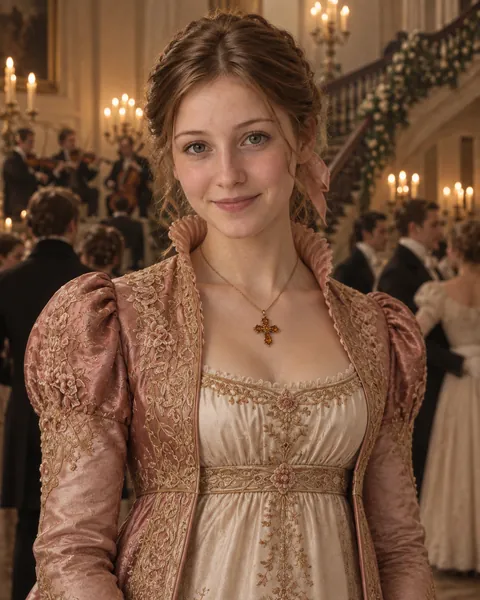 Fanny Price
Her First Ball
Sit as Fanny Price
See yourself in a Regency gown before you sew, hire or buy one.
Regency fashion for men
Men’s dress changed even more than women’s. The silks, embroidery and bright colours of the eighteenth century gave way to sober, superbly cut wool, a revolution usually credited to the dandy George “Beau” Brummell, who made cleanliness, fit and a perfect cravat the marks of a gentleman.
- Tailcoat: dark blue, black, bottle green or brown wool, cut high at the front and long behind, with a high turned-down collar.
- Waistcoat: short, ending at the waist, in white, buff or a quiet pattern.
- Shirt and cravat: white linen with tall collar points, and a starched cravat tied in one of many named knots.
- Legs: knee breeches with stockings, then tight pantaloons, and later in the period trousers strapped under the foot.
- Feet and head: Hessian or top boots by day, pumps for dancing; a tall beaver hat outdoors, and a caped greatcoat in bad weather.
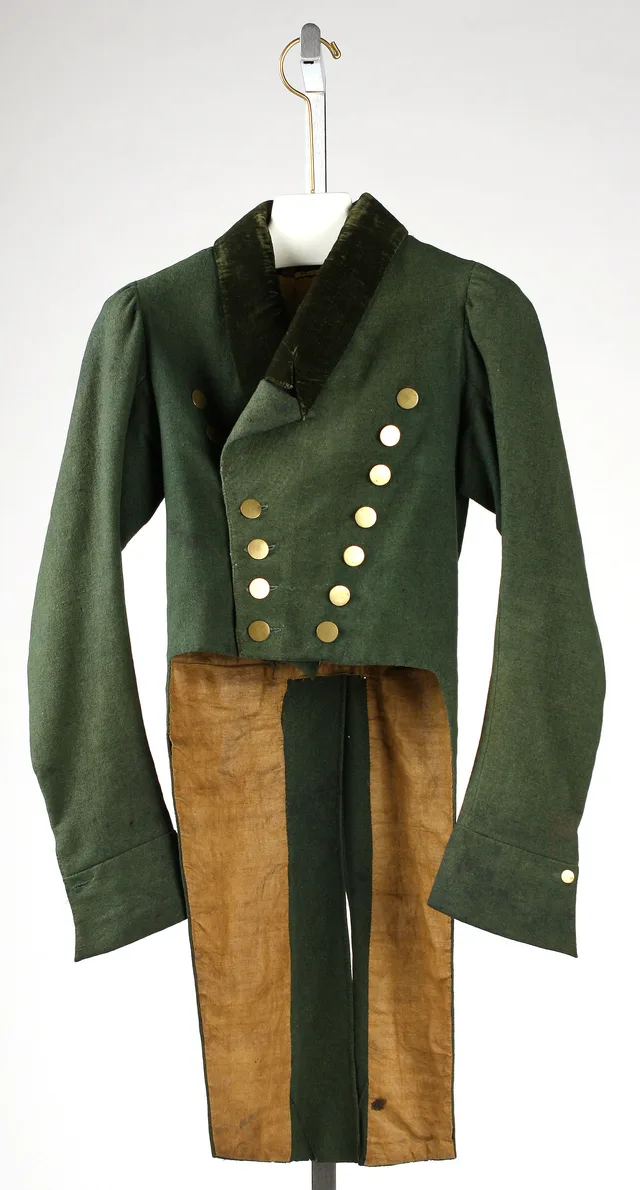
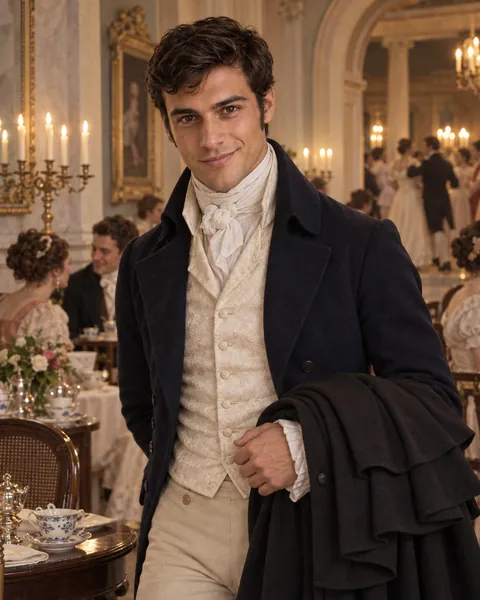
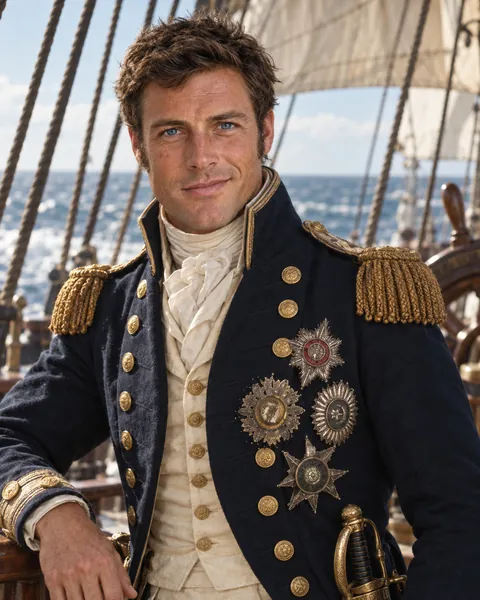
That is how a gentleman like Mr Darcy would dress. Officers like Wickham wore their regimental red, and naval men like Captain Wentworth their blue and gold, which made the militia so dashing to Kitty and Lydia Bennet.
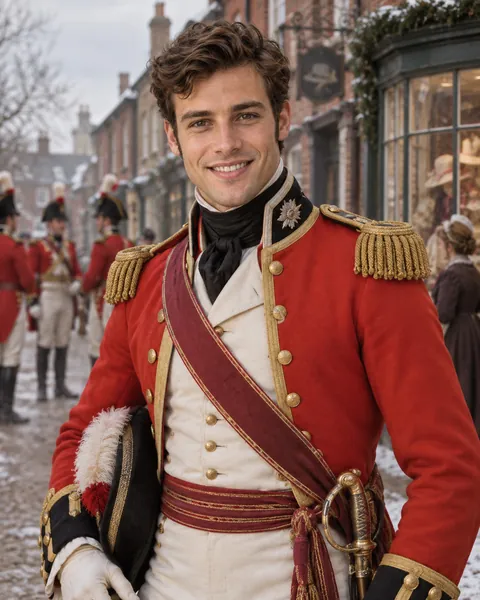
Regency vs Victorian fashion
| Regency (about 1795–1820) | Victorian (1837–1901) | |
|---|---|---|
| Waist | Just under the bust | At the natural waist, tightly corseted |
| Skirt | Narrow, falling straight | Full, over petticoats, then crinolines and bustles |
| Fabric | Light muslin, pale colours | Heavier silks and wools, richer colours |
| Mood | Classical simplicity | Elaborate decoration and structure |
| Men | Tailcoat, breeches or pantaloons | Frock coat, trousers, darker and plainer still |
What to wear to a Regency party or ball
For a costumed ball, a Jane Austen festival or a themed party, aim for the silhouette first and the details second:
- Women: a long, high-waisted gown in white, ivory or a pale colour, with short puffed sleeves for evening; long gloves; a shawl; flat slippers you can dance in; hair up with curls and a ribbon or bandeau.
- Men: a dark tailcoat, a pale waistcoat, a white shirt with a high collar and a tied cravat, pale breeches or trousers, and boots or plain dark shoes.
- Avoid: natural-waist or full-skirted dresses, which read as Victorian, and anything shiny and synthetic.
Your questions
Questions about Regency fashion
Anything else? Write to us at [email protected].
What is Regency era fashion?
The high-waisted, column-shaped style of roughly 1795 to 1820, inspired by classical statues: light muslin gowns for women and dark tailcoats, pale breeches and white cravats for men.
Why were Regency dresses high-waisted?
To create the long, straight line of a Greek or Roman statue. The waist sat just under the bust and the skirt fell straight from it, which also suited the light fabrics of the day.
What years is the Regency era?
The Regency proper was 1811 to 1820, when the Prince of Wales ruled as Prince Regent. In fashion the term usually covers about 1795 to 1820.
Are Regency and Victorian fashion the same?
No. Regency dresses are high-waisted and narrow; Victorian dresses have a corseted natural waist and full skirts. The Victorian era began in 1837.
What is a spencer?
A short, close-fitting jacket ending at the high Regency waistline, worn over a gown for walking out.
What is a pelisse?
A long coat-dress worn over a gown in cold weather, often of wool or silk and sometimes trimmed with fur.
What should I wear to a Regency ball?
Women: a long high-waisted gown with short sleeves, long gloves and flat slippers. Men: a dark tailcoat, pale waistcoat, white shirt and cravat, pale breeches or trousers and boots or plain shoes.
Keep reading
More from the novels
-
Elizabeth Bennet
The quick, laughing heroine of Pride and Prejudice
-
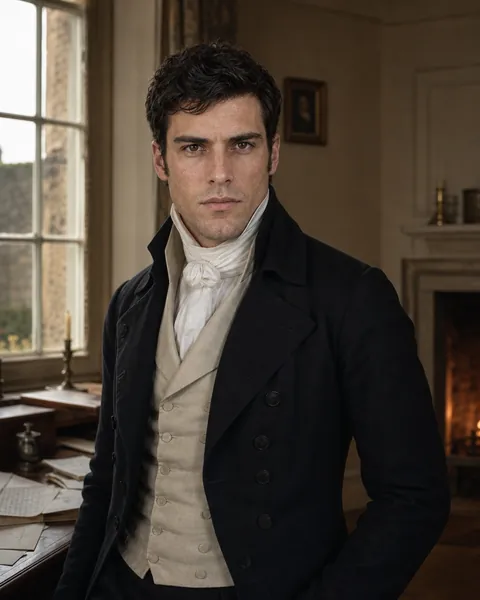 Mr Darcy
Fitzwilliam Darcy of Pemberley, the hero of Pride and Prejudice
-
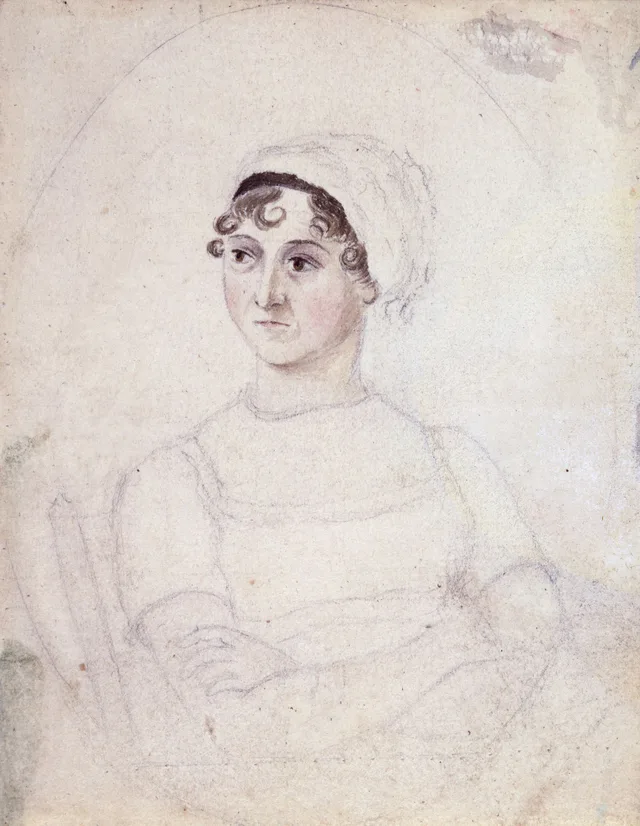 Jane Austen biography
Her life, her family, her six novels and her birthday
-
Jane Austen gifts
Seventeen ideas for the Austen reader in your life
-
 Pemberley, Longbourn and Netherfield
Every house, town and county in Pride and Prejudice
-
 The best Jane Austen book
All six novels, ranked, with the order they were published


Dress is at all times a frivolous distinction, and excessive solicitude about it often destroys its own aim.
Then again, it is very pleasant to look the part. Try on sixty Regency looks in Jane Austen Photo Studio for iPhone. Your first three portraits are free.
 Download on theApp Store

On a computer? Scan with your iPhone camera.